Switching to Life Color Plus: A Conversion Guide for Koleston and Majirel Colourists
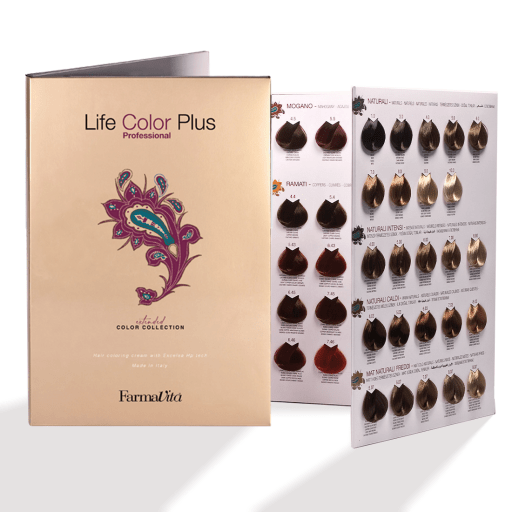
Changing colour house is not really about shades — it is about three things that quietly stop being true when you switch: the numbering, the mixing ratio, and the system your formulas assume. Get those three straight and the rest is a strand test. Here is how to move a column onto Life Color Plus without relearning colour from scratch.

What actually changes
Three things, in ascending order of how much trouble they cause if you ignore them:
- The numbering. Annoying but easy — it is a translation job, and it is the same underlying convention.
- The mixing ratio. The one that catches people out, because it silently changes how strong your developer actually is.
- The system around the colour. Your formulas are not just tubes; they assume a whole set of companion products.
1. Translating the numbering
The good news is that Wella, L'Oréal and Life Color Plus all descend from the same international depth-and-tone convention. Depth first, tone after. Wella writes it with a stroke (7/1); L'Oréal and Life Color Plus write it with a point (7.1). The structure underneath is identical.
Where they diverge is which digit means which tone. For reference, L'Oréal's reflect codes run:
| L'Oréal code | Tone | Nearest family in Life Color Plus |
|---|---|---|
| ,1 | Blue / ash | .1 ash |
| ,2 | Violet / iridescent ash | .2 violet / irisé |
| ,3 | Gold | .3 gold |
| ,4 | Copper | .4 copper |
| ,5 | Mahogany | .5 mahogany |
| ,6 | Red | .6 red |
| ,7 | Green / metallic | .7 brown / mat |
| ,8 | Mocha | — |
The shade chart guide walks through the Life Color Plus side in full, including the doubled digits (7.44, 6.66) that signal an intensified reflect.
We are not going to hand you a conversion table, and you should be suspicious of anyone who does.
Every colour house uses its own pigments and its own base. A 7.1 in one line is genuinely not a 7/1 in another — colourists consistently report that L'Oréal's blondes read warmer and more gold than Wella's at the same nominal code. A published one-to-one lookup table would be a guess dressed up as a fact, and it would be your client's hair paying for it. Translate the intent — depth, dominant reflect, how much white — then strand test.
2. The maths nobody explains: effective developer strength
This is the section worth the read. The mixing ratio changes how strong your developer actually is on the head, because peroxide is diluted by the colour it is mixed with.
Take the same bottle of 20 volume and mix it three different ways:
| Ratio | Developer as a share of the mix | Effective strength from a 20 vol bottle | Lines that mix this way |
|---|---|---|---|
| 1:1 | 50% | ≈ 10 vol | Koleston Perfect ME+, INOA |
| 1:1.5 | 60% | ≈ 12 vol | Life Color Plus, Majirel |
| 1:2 | 67% | ≈ 13.3 vol | Koleston special blondes |
What this means if you are coming from Koleston
Your usual 20 volume will run slightly hotter here, not cooler — roughly an effective 12 volume instead of 10, because Life Color Plus takes more developer per part of colour. Expect a touch more lift than you are used to on the first few heads, and formulate half a step cooler if a client is sensitive to warmth.
What this means if you are coming from Majirel
Nothing changes on the ratio at all — Majirel is also 1:1.5. Your developer instincts transfer directly. The variables are pigment and base, not chemistry, so go straight to strand testing tone.
This is also why the "10 vol or 20 vol for grey?" argument never resolves on the forums. Everyone is quoting a rule that was correct on the line they learned it on. The Life Color Plus answer — 20 volume for full white coverage, with a 1:1 ratio and half a natural in the mix — is set out in the grey coverage guide.
3. The system, not the tube
Colourists rarely choose a permanent line on its own. You choose it alongside whatever you use for toning, refreshing mid-lengths and softening a regrowth line — Koleston users tend to pair with Color Touch, Majirel users with Dia. When you move the permanent, you are implicitly moving the whole set.

On this line the low-lift end is handled by developer strength. 10 volume gives you tone-on-tone, deposit-only results with no lift, over a 30–40 minute development, and there is a dedicated Life Color Tone on Tone cream developer for that work. That is the route for refreshing mid-lengths and ends, softening a demarcation line, or toning without touching the client's depth.
Plan this before you switch, not after. The first time you need a gloss on a regrowth client and find you have only 20 volume on the shelf is not the moment to work it out.
The rules you should not bend
- Never mix colour from one house with developer from another. The pH, the alkalising agent and the pigment system are all designed together. Cross-mixing is not thrift, it is an unpredictable result on a paying client — and it voids any support you would otherwise have from the manufacturer.
- Cross-brand conversions are approximate by nature. Not because anyone is being cagey, but because proprietary pigments genuinely do not map one to one.
- Expect systematic tonal drift, not random error. Whole colour houses run warmer or cooler than each other in a consistent direction. Once you have done ten heads you will know which way this line runs on your clients, and you can formulate for it permanently.
- Test as though every client were new, because on a new line they effectively are: skin test, strand test, and an incompatibility test on anyone with a history of box colour or henna.
A trial protocol that will not cost you a client
Do not switch the salon over a weekend. Switch one column over a month:
- Week 1 — regrowth only. Root applications on clients whose history you know inside out. Lowest risk, fastest feedback, and it exercises the grey protocol which is where most of your work lives anyway.
- Week 2 — add mid-lengths and ends. Now you are testing how the pigment reads on previously coloured hair.
- Week 3 — the tonal clients. The ash-sensitive, the ones who will tell you immediately if something has gone warm. Their feedback is worth more than anyone else's.
- Week 4 — review and decide. How many tubes did you actually use? What was the cost per head? Did anything need correcting?
Write the formula down every time, including the developer volume and the timing. Four weeks of that gives you a translation table built on your own clients, which is worth considerably more than any published one.
The cost per service breakdown shows how to turn week four's tube count into a real number.
The honest cost of switching
There is one, and it is not the stock. It is the fortnight where you are formulating consciously instead of automatically — checking the chart, thinking about the reflect, strand testing things you would normally not think twice about. For a busy colourist that is a real tax on the working day, and it is the reason plenty of good stylists stay where they are.
It is also finite. Formulating on a new line stops being deliberate somewhere around the thirtieth head, and after that the only thing that has changed is what is on the shelf.
Start with one column
A handful of the naturals you use daily, a bottle of 20 volume, and the chart. That is a trial, not a stockroom commitment.
Life Color Plus — 160 variants, £3.49 →
Life Professional Cream Developer, £3.65 →
The full salon shade chart →
Part 4 of 5 — Life Color Plus in the salon.
Previously: ← Reading the shade chart
Next: What is actually in the tube →
Competitor product information is given for reference only and is drawn from those manufacturers' own published guidance. Always work to the current instructions supplied with whichever product you are using, and never mix colour and developer from different manufacturers.
-
Posted in
colour theory, Life Color Plus, salon business, switching brands, trade