100% Grey Coverage With Life Color Plus: The Formula, Developer and Timings
Grey coverage is where colour brands are actually judged — and where the rules stubbornly refuse to transfer between them. This is the Life Color Plus protocol in full: the mixing formula for heavy white, the developer to reach for, the timings, and what to do when a resistant root still will not take.

Why your grey rule does not travel
Go on any UK stylist forum and you will find the same argument running for years: 10 volume or 20 volume for grey? Colourists trained in the same salon give different answers. Everyone is convinced, and everyone is quoting a rule they learned on a different colour line.
They are all partly right, because the mixing ratio changes the developer's effective strength. A line mixed 1:1 dilutes 20 volume down to roughly 10 volume in the bowl. A line mixed 1:1.5 — which includes Life Color Plus — lands nearer an effective 12 volume from the same bottle. A 1:2 line lands higher still. So "I always use 20 vol on grey" is not a portable instruction; it is a statement about one brand's chemistry.
There is no universal grey rule. This is the single point every experienced colourist in those threads agrees on, and it is the reason a brand-specific protocol is worth reading rather than assuming. What follows is Farmavita's own for Life Color Plus.
Why white hair fights you
Before the formula, the reason for it. White hair is not simply hair with the colour switched off — it usually behaves differently on the head:
- There is no underlying pigment to work with. On pigmented hair, a reflect tone lands on top of an existing warm base and the two combine. On white there is nothing underneath, so a reflect applied alone reads thin, translucent and unconvincing. This is the whole reason the protocol adds a natural.
- It is often coarser and more tightly cuticled. Resistant white — the glassy, wiry kind, typically at the temples and front hairline — is physically harder for the colour to get into. Two clients with the same percentage of white can need quite different handling.
- It is rarely evenly distributed. Almost every head is heavier at the temples and the parting than at the nape, and a formula built for the average will under-cover the areas the client actually looks at in the mirror.
Step one: assess the percentage, not the look
The protocol forks at 50%. Everything downstream depends on getting that judgement right, so make it deliberately — section the hair at the crown and the temples, look at the density of white in each area separately, and formulate for the heaviest section rather than the average. Most heads are not uniform, and the temples are usually ahead of the rest.
Up to 50% white hair
Straightforward: apply the desired shade on its own. No natural added, standard 1:1.5 ratio, and increase the processing time by five minutes over what you would give the same shade on pigmented hair.
That five minutes is the part that gets skipped, and it is the most common reason a light scattering of white looks slightly translucent at the root a fortnight later.
50–100% white hair — the formula
This is the one to commit to memory. For heavy white, the mix must be half natural:
The 50–100% white formula
Half a tube of the desired shade + half a tube of the natural shade at the same depth
Mixed at 1:1 with developer — not the standard 1:1.5
Worked example: for a 6.35 result on a 70% white head, mix 50ml of 6.35 + 50ml of 6.0, then add 100ml of developer.
Two things are doing the work here. The natural shade supplies the base pigment that white hair has none of — without it you are asking a reflect tone to build colour on an empty canvas, which is precisely why bright coppers and ash tones slide off grey. And the 1:1 ratio makes the mix more concentrated, so there is more dye per millilitre sitting on the hair.
Finding the right natural
Match the depth, then pick the natural. Life Color Plus carries several natural variants at each depth, and they are not interchangeable:
| Code | What it is | Reach for it when |
|---|---|---|
| .0 | The standard natural series | Your default partner shade for heavy white |
| .00 | Intensified natural | Resistant white, or a head that has historically faded fast |
| .03 | Warm natural | You want the coverage without the result going flat or cool |
| .07 | Natural with a cooler cast | Covering white without pulling warm on a client who hates gold |
On this site the naturals run from depth 4 through depth 10, so whatever depth you are targeting through the mid-range, the partner shade exists. Browse the full list on the Life Color Plus shade page, and see the shade chart guide for how the numbering works.
Which developer, and for how long
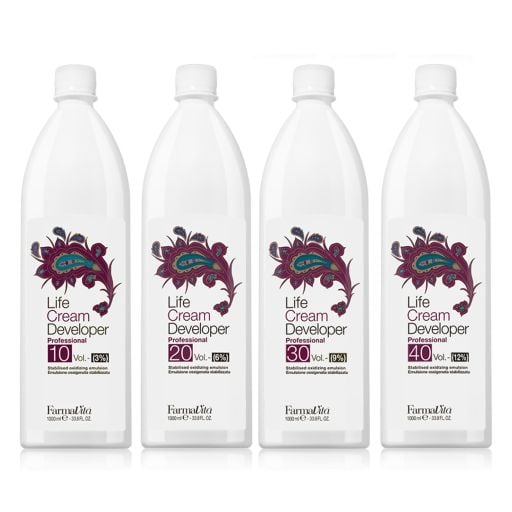
Life Professional Cream Developer comes in four strengths on this site. This is what each is for:

| Developer | Use it for | Development time |
|---|---|---|
| 10 vol · 3% | Tone-on-tone, deposit only, no lift | 30–40 min |
| 20 vol · 6% | Covering white hair, up to 2 tones of lift | 30–45 min |
| 30 vol · 9% | 2–3 tones of lift | 30–40 min |
| 30 or 40 vol · 9% / 12% | 4–5 tones of lift, with the Superlightener series (which mix 1:2, not 1:1.5) | 40–45 min |
For 100% white coverage: 20 volume (6%), and give it the full 45 minutes. The table's 30–45 minute window is the general range for that strength; on solid white the manufacturer's recommendation for the best result sits at the top of it. Pulling the client early is the most common self-inflicted coverage failure.
Reaching for 30 volume "to make it grab harder" is a common instinct and usually the wrong one. Higher volume lifts more of the client's remaining natural pigment — it does not deposit more dye. On a head that is largely white there is very little left to lift, so all you gain is a lighter, warmer result that reads as poorer coverage, not better.
Virgin hair, first application
On a first full-head application, work in two stages for a total of roughly 40 minutes: around 20 minutes on the lengths and ends first, then apply the roots and give them a further 20. Applying everything at once on a virgin head is how you end up with hot roots and under-processed ends in the same service.
When a resistant root still will not take
Some white hair is simply obstinate — coarse, glassy, tightly cuticled, often at the temples and the front hairline. If you have followed the protocol and the coverage is still patchy, the following are the adjustments working colourists reach for:
- Thicken the mix. Slightly less developer gives a denser mix that sits on the hair rather than running off it
- Extend the development. Resistant hair often needs longer than the standard window
- Pre-soften the roots before the colour application proper
- Apply gentle heat to open a stubborn cuticle
- Colour on freshly washed hair rather than second-day hair, so there is no barrier of product or sebum
- Apply to the most resistant areas first — usually the temples and front hairline — so they get the longest development, and section using a brickwork pattern so no white is shadowed by the section above
These six are practitioner technique, not manufacturer instruction. They come from working colourists rather than from Farmavita's documentation. They are widely used and they work, but they are adjustments made on your own professional judgement — the manufacturer's protocol is the formula and the timings above.
Testing — the part that is not optional
On any client whose hair has been chemically treated before, and on every new client regardless, three tests apply:
- Incompatibility test — for metallic salts from box colour or home henna, which can react violently with peroxide
- Strand test — the only reliable way to know how a specific head will take a specific formula
- Skin (patch) test — required before every colour service, in line with the manufacturer's instructions and your insurer's terms
Life Color Plus is an ammonia-based permanent colour for professional use only. What that means for the formulation, and where the aftercare protection actually comes from, is covered in part five.
The regrowth client, six weeks later
The first application is the one everyone plans for. The regrowth appointments are where grey coverage actually gets won or lost, because you are now solving two problems at once: fresh white at the root, and eight weeks of fade on the lengths.
Treat them as two applications, not one. Put the full grey formula on the regrowth and give it the development time it needs. The lengths and ends do not need the same product — they have pigment in them already, and hitting them with 20 volume every six weeks is how ends end up over-processed and flat by the spring.
For the lengths, a deposit-only refresh in the last ten minutes does the job: the same or a slightly lighter shade on Tone on Tone developer or 10 volume, emulsified through, purely to bring the tone back up. It costs a few pence and it is the difference between a client whose colour looks fresh all over and one whose roots look great against tired ends.
Inheriting someone else's formula
A client arrives with a formula written on the back of a card by a stylist you have never met, possibly trained on a different line, possibly in a different country. It is one of the quietest ways to lose a client in the first six weeks.
Do not transcribe it. Read it for intent — what depth were they aiming at, what reflect, how heavy was the white — then formulate it fresh on this line, using the protocol above. A shade number from another colour house is not a shade number here, and the conversion guide explains why a straight translation is never quite a translation.
The protocol on one card
Up to 50% white
Desired shade alone · standard 1:1.5 · add 5 minutes to the normal time
50–100% white
Half desired shade + half natural at the same depth · mixed 1:1 · 20 vol (6%) · 45 minutes
Virgin head, first application
Lengths and ends first for ~20 min, then roots for a further ~20 min
Regrowth appointment
Full grey formula on the root · deposit-only refresh on the lengths in the last 10 minutes
Everything you need for the protocol
The formula above needs three things on the shelf: your target shade, the matching natural at the same depth, and 20 volume developer.
Life Color Plus — 160 variants, £3.49 →
Life Professional Cream Developer, 20 vol →
The full shade chart for the salon →
Part 2 of 5 — Life Color Plus in the salon.
Previously: ← What a colour service really costs you
Next: Reading the shade chart — depth, tone, toners and superlighteners →
Life Color Plus is a professional product for salon use only. Always follow the manufacturer's current instructions supplied with the product, and carry out the required skin, strand and incompatibility tests before every service.
-
Posted in
developer, grey coverage, Life Color Plus, technical, trade