What a Colour Service Really Costs You: Life Color Plus Tube Yield and Cost Per Head
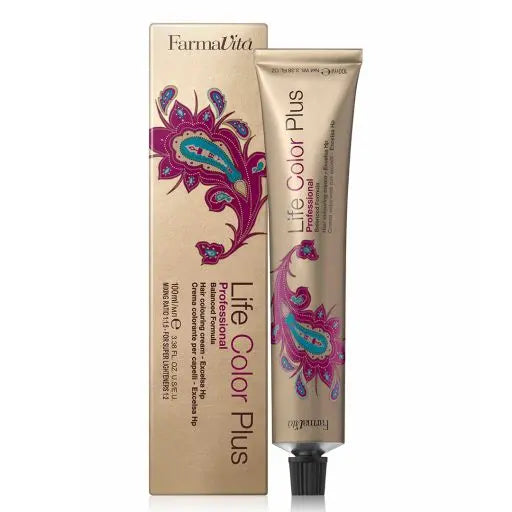
Most salons know what a tube of colour costs. Far fewer know what a head of colour costs — and that is the number your price list should actually be built on. Here is the arithmetic, with every figure taken from the prices on this site, so you can run it against whatever you use now.

The number salons never actually calculate
Ask a salon owner what their colour costs and you will usually get a price per tube. It is the wrong unit. A tube is not what you put on a client's head — mixed product is. And how much mixed product a tube gives you depends on the mixing ratio, which is different for every colour house.
That is why "brand A is cheaper than brand B" is so often wrong. A tube that costs more but mixes further can easily be the cheaper service. To compare honestly you need three numbers:
- Tube size — how much colour you are buying
- Mixing ratio — how much developer that colour takes
- How much mixed product a head actually consumes in your salon
The first two are fixed by the manufacturer. The third is yours, and it is the one nobody else can tell you.
What a tube of Life Color Plus yields
Life Color Plus is a 100ml tube, mixed at a standard ratio of 1:1.5 — 50ml of colour to 75ml of Life Cream Developer, or a full tube to 150ml.
One full tube at the standard ratio
100ml colour + 150ml developer = 250ml of mixed product
There is a second official ratio. Mixed 1:1 — a full tube to 100ml of developer — you get a stronger, more intense result. That is the ratio the manufacturer specifies for heavy white coverage, which we cover in detail in the grey coverage guide. It gives you 200ml of mix instead of 250ml, so it is worth costing separately.
The cost per head, three ways
At the prices listed on this site — £3.49 a 100ml tube and £3.65 a litre of Life Professional Cream Developer (which works out at just over a third of a penny per ml) — the maths runs like this.
| Application | Colour | Developer | Mixed product | Product cost |
|---|---|---|---|---|
| Half a tube (regrowth / short hair) | 50ml | 75ml | 125ml | £2.02 |
| One tube, standard 1:1.5 | 100ml | 150ml | 250ml | £4.04 |
| One tube, intense 1:1 | 100ml | 100ml | 200ml | £3.86 |
| A tube and a half (long, thick hair) | 150ml | 225ml | 375ml | £6.06 |
Prices as listed on this site and correct at the time of writing. Developer costed pro-rata from the 1 litre bottle.
Notice what the table does not do: it does not tell you how much mix a head takes. That is deliberate. A regrowth on a bob and a full head on mid-back hair are not the same service, and any brand that quotes you a single "cost per client" figure has invented it. Take the row that matches your average and work from there.
What that looks like across a week
Take the middle row — one full tube at the standard ratio, £4.04 of product on the head — and scale it to a column's worth of colour work:
| Colour clients per week | Product cost per week | Per year |
|---|---|---|
| 12 | £48.48 | £2,521 |
| 25 | £101.00 | £5,252 |
| 40 | £161.60 | £8,403 |
Whatever your current colour spend is, that comparison is a two-minute job and it is the only one that matters. Pull last quarter's colour invoices, divide by the number of colour services you did, and put the result next to the middle row above.

Where the ratio comparison gets misused
Colour houses mix differently, and the difference is real. For reference:
- Wella Koleston Perfect ME+ mixes 1:1 with Welloxon Perfect ME+ (1:2 for special blondes)
- L'Oréal Majirel mixes 1:1.5 with L'Oréal oxydant
- Life Color Plus mixes 1:1.5, with a 1:1 option for a stronger result
Here is the honest reading of that. A 1:1.5 line does stretch further per millilitre of colour than a 1:1 line — which is exactly why stylists on the trade forums say a Majirel tube "goes further" than a Wella one. But Majirel is a 1:1.5 line too. So against Majirel, the ratio is not a differentiator at all — the only thing that separates them on cost is the unit price of the tube and the tube size.
Compare like for like. A 100ml tube at 1:1.5 and a 60ml tube at 1:1.5 do not yield the same mix — the 100ml tube gives 250ml, the 60ml tube gives 150ml. Always divide the tube price by the millilitres of mixed product it produces, not by the tube.
Where the maths changes
Four situations move the number, and they are worth knowing before you build a price list around an average:
- Heavy white coverage. The manufacturer's protocol for 50–100% white uses a 1:1 ratio and half a tube of a natural shade alongside the target shade. Same quantity of colour, less developer, and the mix is more concentrated — cost per head goes up slightly, coverage goes up a lot. Full protocol here.
- Superlighteners. The 900 and 12-series shades mix at 1:2 — 50ml of colour to 100ml of 40 volume — not the standard 1:1.5. More developer per tube, so cost the super-bleaching services separately.
- Long or thick hair. The tube-and-a-half row exists for a reason. If a meaningful share of your column is mid-back or thicker, that row is your real average, not the one-tube row.
- Second application. Root-then-lengths timing on a virgin head is one service but not always one tube.
The counter-argument, stated fairly
Plenty of experienced colourists do not switch brands over cost per head — they surcharge for long hair instead, and they are not wrong to. If your column is loyal, your formulas are dialled in and your clients accept a length surcharge, product cost is genuinely not your biggest lever, and changing colour house carries a retraining cost that a spreadsheet will not show you.
The salons where this arithmetic actually changes something are the ones running high colour volume on tight margins, opening a second chair, taking on a trainee's column, or absorbing a price rise they cannot pass on. If that is you, the difference between £4.04 and whatever you currently spend, multiplied by 40 heads a week, is a number worth an afternoon.
How to test it without committing the stockroom
Do not order a range. Order a handful of the depths you use most — the naturals you reach for every day — plus one bottle of 20 volume developer. Run them on one column for a month, on regrowth first, and keep a note of how many tubes you actually get through. That gives you a real cost per head on your own clients rather than a manufacturer's one.
The switching guide covers how to translate the formulas you already know, and what to expect in the first ten heads.
Run the numbers on your own column
Life Color Plus is £3.49 a 100ml tube with 160 shade, corrector and toner variants to choose from, and Life Professional Cream Developer is £3.65 a litre in 10, 20, 30 and 40 volume.
Go deeper
Which shades to stock first →
Cutting colour waste →
Explaining colour prices to clients →
Part 1 of 5 — Life Color Plus in the salon.
Next: 100% grey coverage — the exact formula, developer and timing →
Prices shown are those listed on lifecolorplus.co.uk and are correct at the time of writing. Life Color Plus is a professional product for salon use only — always follow the manufacturer's instructions and carry out the required tests before every service.
-
Posted in
colour costs, Life Color Plus, salon business, trade