What's Actually in Life Color Plus: Excelsa HP, Ammonia and Colour Aftercare
Colour brands are not always straight about what is in the tube, and the hair industry has a particular weakness for implying gentleness that the formulation does not support. So here is Life Color Plus described accurately — the technology, the ammonia question answered plainly, and where the actual hair protection comes from, which is not where most people assume.

Excelsa HP
The signature technology in Life Color Plus is branded Excelsa HP. Behind the name are low molecular weight oligopeptides produced by the enzymatic hydrolysis of Brazil nut — Bertholletia excelsa, which is where the name comes from.
The reasoning is straightforward enough: small peptide fragments are small enough to penetrate rather than simply sit on the surface, and the intention is to support the hair through the colouring process rather than treat it afterwards. It is the same broad category of thinking as the wheat and silk protein systems other Italian houses build on.
Worth knowing if you have a nut allergy in the client chair. The technology is derived from Brazil nut. Hydrolysed derivatives are not the same thing as the whole nut protein, but it is a conversation worth having during consultation rather than after, and the patch test is not optional regardless.
The ammonia question, answered straight
Life Color Plus is an ammonia-based permanent colour. It is not an ammonia-free line and it has never claimed to be one. The official shade chart carries the standard European declarations — ammonia, benzenediamines, resorcinol and toluenediamines — and the product is marked for professional use only.
What the brand does claim is narrower and more specific: the formulation includes a raw material that absorbs and destroys the smell of ammonia. That is a genuine benefit, and it is a benefit to the room rather than to the hair. Anyone who has run three colour clients back to back in a small salon on a warm afternoon knows exactly how much that is worth. But it is an odour claim, not a gentleness claim, and the two get conflated constantly.
The confusion worth clearing up: B.Life Color is a different product.
Farmavita also makes B.Life Color, which is the ammonia-free line, and is the one enriched with argan oil — a range of 65 shades plus 12 toners, mixed at 1:1.5. If you have read that Life Color Plus is ammonia-free or argan-enriched, that claim belongs to B.Life. The two lines are separate products with separate chemistry, and treating them as interchangeable will eventually cost somebody a result.
Why an ammonia-based permanent is still the right tool
Ammonia has spent a decade being marketed against, largely by products that need a reason to cost more. It is worth remembering what it is actually for.
Ammonia raises the pH and swells the cuticle so that dye precursors can get inside the cortex and develop there. That is what makes a permanent colour permanent. Take it out and you need an alternative alkalising agent, and you generally trade away some combination of lift, coverage on resistant hair, and longevity.
Which is why the jobs Life Color Plus is specified for are exactly the jobs that need it:
- 100% coverage of white hair — including the resistant, glassy white at the temples that demi-permanents leave translucent. The full grey protocol is here.
- Four to five tones of lift with the superlightener series and a 30 or 40 volume developer.
- Colour that survives the client's own shampoo for the eight or nine weeks between appointments.
For comparison, Wella's own published guidance puts its demi-permanent at up to 70% grey coverage and reserves complete coverage for its permanent line. That is not a knock on demi-permanents — it is a statement about what each chemistry is for. If you want deposit-only, no-lift work on this line, that is what 10 volume and the Tone on Tone developer are for.
Professional use only, and the tests that go with it
This is a professional product, sold on the assumption that a trained colourist is applying it. Three tests apply before service, every time:
- Skin (patch) test — before every colour service, per the manufacturer's instructions and your insurance terms
- Strand test — the only way to know how this specific head will take this specific formula
- Incompatibility test — on any hair with a history of box colour or home henna, where metallic salts can react with peroxide
Where the protection actually comes from
Here is the part the industry gets backwards. The protection in a colour service is not in the colour. It is in what you put on the hair before, during and after it — and that is a decision you make, not one the tube makes for you.
During the service: the bond system

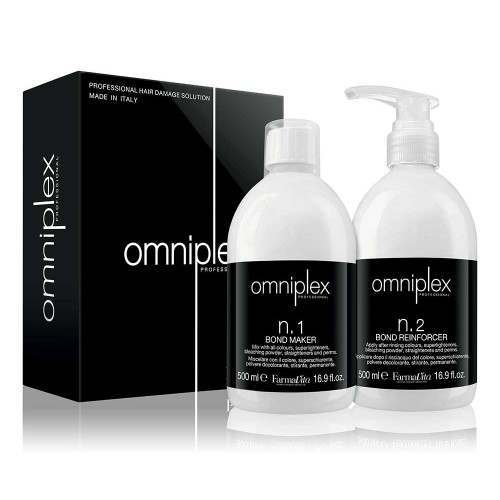
Omniplex is the bond builder that runs alongside the colour:
- Scalp Protector — applied before the service, for sensitive scalps and heavy full-head work
- N°1 Bond Maker and N°2 Bond Reinforcer — the two-step system, N°1 into the mix, N°2 after rinsing
- The salon kit — the 1000ml format for a busy colour bar, and a compact kit for lower volumes or mobile work
Bond protection matters most exactly where this line works hardest: superlightener work, repeated full-head applications, and anything on hair that has been coloured before. If you are running the 900 or 12 series, budget for it as part of the service rather than as an add-on.
Afterwards: the client's own shelf

What the client does for the next eight weeks decides how your work looks when they walk back in. Four things carry most of the load:
- Omniplex N°3 Miracle — the at-home continuation of the bond system
- Blossom Glow bond care shampoo and mask — the retail-sized pairing, also available in 1000ml for the backbar
- Argan Sublime — shampoo, mask and the Elixir, for condition and shine on lengths that have been through a lift
- Amethyste Silver — the violet shampoo for blondes and for clients wearing their grey, which is the difference between a cool blonde at week two and a yellow one at week five

The retail conversation you are probably not having
Wella's own consultation research puts it at 96% of clients expecting a product recommendation from their stylist. Which means that for almost every client in the chair, saying nothing is not neutral — it is a slightly worse experience than the one they came in for.
The recommendation also does not need to be a sales pitch. "Your ends have taken a lot of lift today, so this is what I'd use twice a week to keep them feeling like this" is a technical statement, and it happens to be true. If you have just told a client their hair needed bond protection during the service, the take-home step is the obvious end of the same sentence.
It is also the difference between a colour service that pays once and a colour client whose regrowth appointment looks as good as their first one did.
Build the service around the colour
Omniplex bond system →
Argan Sublime →
Amethyste →
Backbar sizes →
Life Color Plus — 160 variants, £3.49 →
Part 5 of 5 — Life Color Plus in the salon.
Previously: ← Switching from Koleston or Majirel
Start the series: What a colour service really costs you →
Ingredient and technology information is drawn from the manufacturer's own published product documentation. Life Color Plus is a professional product for salon use only — always read and follow the current instructions and warnings supplied with the product, and carry out the required tests before every service.
-
Posted in
aftercare, ingredients, Life Color Plus, Omniplex, trade