Life Color Plus Colour Chart, Mixing Ratio and How to Use It
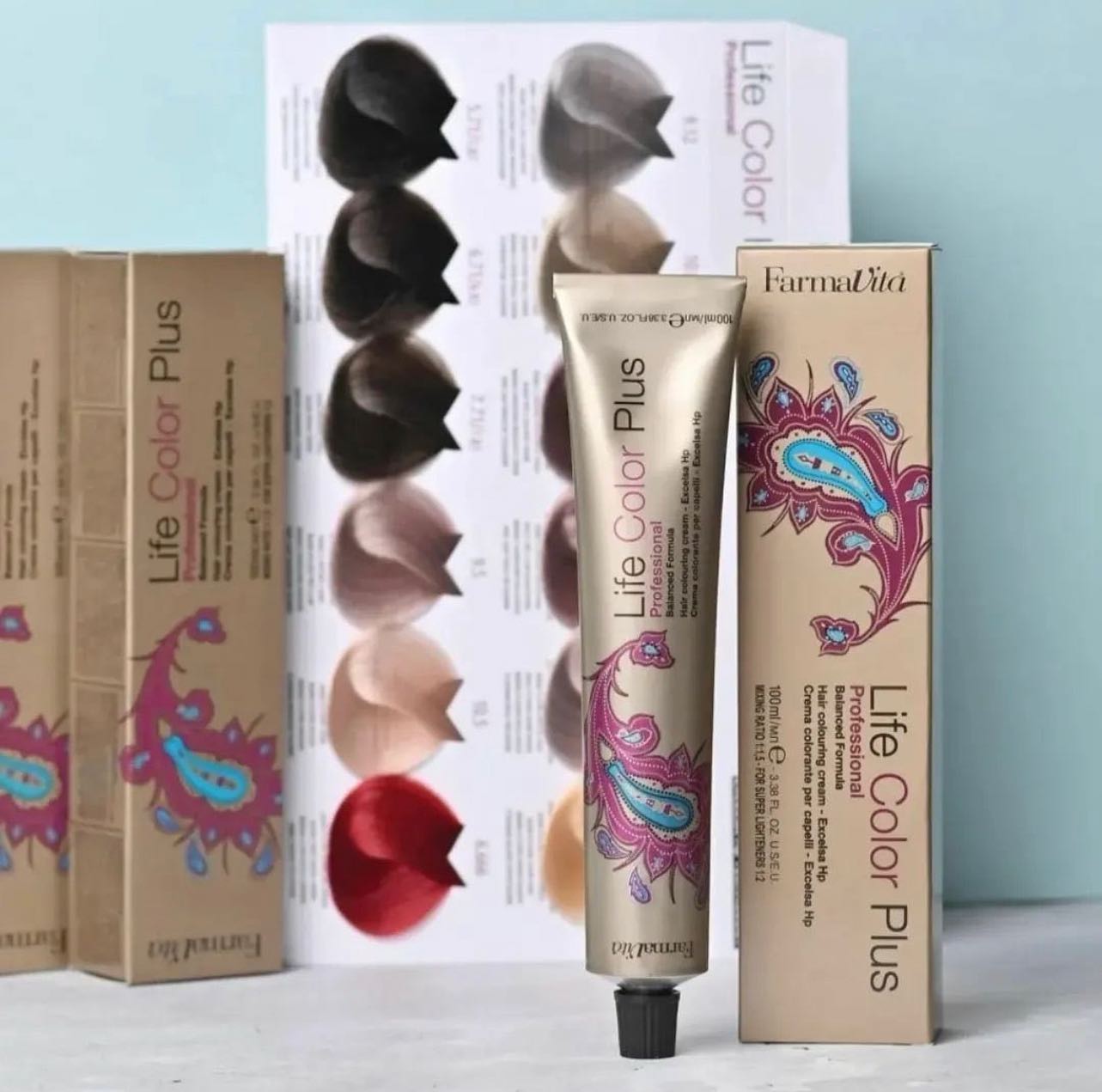
Life Color Plus is FarmaVita's ammonia-based permanent salon colour: 160 variants, correctors and toners included, with the standard shades coded depth.reflect, so 7.43 is a level 7 blonde with a copper lead and gold behind it. Mix 50ml of colour to 75ml of Life Cream Developer (1:1.5) as standard, 1:1 for a more intense result (the ratio this site's grey guides use over 50% white), and 1:2 with 40 volume for the 900 and 12 series superlighteners. Patch test 48 hours before every service and allow 25–45 minutes' development, as the developer listing states; on solid white at 20 volume, this site's grey protocol gives the full 45.

This page is the quick reference; each section links to the full guide behind it.
Life Color Plus at a glance
| Job | Formula |
|---|---|
| Before any service | Patch test 48 hours ahead (the listing's directions); strand test on any colour history |
| Standard colour | 1:1.5: 50ml colour + 75ml developer at 20, 30 or 40 volume |
| Stronger colour | 1:1: 50ml colour + 50ml developer |
| 900 and 12 series superlighteners | 1:2: 50ml colour + 100ml of 40 volume (12%) |
| Over 50% white (this site's protocol) | Half target shade + half natural at the same depth, 1:1, 20 volume, 45 minutes |
| Virgin hair, first application | Lengths and ends first (about 20 minutes), then roots (about 20 more) |
How does the Life Color Plus colour chart work?
Life Color Plus uses the depth-and-tone numbering shared by most European colour houses. Every code is two pieces of information separated by a point:
- The number before the point is the depth, from 1 (black) through 3 (dark brown), 4 (brown), 5 (light brown), 6 (dark blonde), 7 (blonde), 8 (light blonde), 9 (very light blonde) and 10 (lightest blonde), then a 12 series for high lift. There is no depth 2 in this range.
- The digits after the point are the reflect. The first is the dominant tone and the second modifies it, so 7.43 is a level 7 with a copper lead and gold behind it.
- A repeated digit intensifies the tone. 7.44 is 7.4 with more copper; .00 is an intensified natural; 6.666 is the most saturated red in the range.
Reflect key: 0 natural, 1 ash, 2 violet, 3 gold, 4 copper, 5 mahogany, 6 red, 7 mat/brown. Read with that key, codes from the range decode like this:
| Code | Depth | Reflect |
|---|---|---|
| 6.03 | Dark blonde | Natural, warmed with gold |
| 7.13 | Blonde | Ash, with gold behind it |
| 7.46 | Blonde | Copper, with red behind it |
| 7.64 | Blonde | Red, with copper behind it |
| 5.12 | Light brown | Ash, with violet behind it |
| 0.22 | No depth | Violet corrector, mixed into another shade |
7.46 and 7.64 use the same two digits and are different shades: the first digit after the point leads. Change the depth and you change how light the client is; change what follows the point and you change the tone at the same depth. The numbering is shared with other lines but the pigments are not, so use the code to navigate and the printed chart plus a strand test to judge what a shade actually does.
The 160 variants, family by family
The range is 160 variants, every one £3.49 a 100ml tube, so the exact shade never costs more than the nearest substitute. Counts are from the live variant list:
| Family | Reflect | Variants | Where they sit |
|---|---|---|---|
| Naturals | .0, .00, .03, .07, plus 9.02, 10.02 and 10.021 | 29 | Depths 1 and 3 to 10 |
| Ash | .1 (with .11, .12, .13, .15), plus 10.102 | 25 | Depths 4 to 10, plus 1.10 |
| Violet / irisé | .2 | 10 | Half at depths 9 and 10; the rest at 4 to 8 |
| Gold | .3 | 20 | Depths 4 to 10 |
| Copper | .4 | 14 | Depths 4 to 8 |
| Mahogany | .5 | 8 | Depths 4, 5, 6, 9 and 10 |
| Red | .6 | 9 | Depths 5 to 8, including 6.666 |
| Mat / brown | .7 | 16 | 4.77 up to 10.72 |
| 900 series superlighteners | Three digits, no point | 6 | 900, 901, 902, 903, 911, 912 |
| 12 series superlighteners | 12 plus a reflect | 14 | 12.0 to 12.89, plus 12.021, 12.022 and 12.122 |
| Correctors | 0.22, 0.44, 0.66 | 3 | No depth: violet, copper, red |
| Pure toners | Named by colour | 6 | Pink, Red, Violet, Blue, Green, Yellow |
A note on labels: the shade-chart listings describe the coloured shades (Blue, Green, Yellow, Red, Violet) as correctors; this site calls them toners to separate them from 0.22, 0.44 and 0.66.
- The naturals are 29 of 160, under a fifth of the range, and on a column with a lot of grey they run down fastest, because the heavy-white formula is half natural (see stock control across 160 variants). At depths 5 to 8 there are four of them and they are not interchangeable: .0 is the default, .00 is for resistant white, .03 leans warm and .07 cooler. See the naturals guide.
- Where a family stops tells you something. In the standard series, copper and red stop at depth 8. Above that, warm high lift is in the 12 series (12.43 copper-gold, 12.61 red-ash), or it is a lift-then-tone job.
- Correctors push a formula; toners are a formula. Corrector quantities come off the shade chart; toners go on pre-lightened hair. The correctors and toners guide has the pairs.
The full walk-through, with worked examples, is in the shade chart explained.
Is there a Life Color Plus colour chart or technical manual PDF?
Not from this site. The figures a technical sheet would give you, the 1:1.5, 1:1 and 1:2 measures, are in the tables on this page, taken from the directions on the product listing, alongside the grey-coverage rule this site's guides use. The printed chart comes in two formats: the big salon chart (39cm × 27.5cm, £83.49) for the consultation area and the mini chart (£29.34) for a kit bag. A screen shows colour according to its own brightness and white balance, so a printed swatch held against the hair under salon lighting is the closer guide, and the strand test is the check.
What is the Life Color Plus mixing ratio?
There are three, and the job decides which one, not habit:
| Ratio | Measure | Use it for | Developer | A full 100ml tube makes |
|---|---|---|---|---|
| 1:1.5 | 50ml + 75ml | Standard work, up to 50% white | 20, 30 or 40 vol, as the service needs | 250ml of mix |
| 1:1 | 50ml + 50ml | A more intense colour; over 50% white on this site's grey protocol | 20, 30 or 40 vol; 20 vol for white coverage | 200ml of mix |
| 1:2 | 50ml + 100ml | The 900 and 12 series only | 40 vol (12%) | 300ml of mix |
Where the figures come from. The directions on the Life Color Plus listing say to pour 50ml of colour into a plastic container and mix it with "75 ml of Cream Developer at 20, 30, or 40 volumes, or 100 ml at 40 volumes in case of super-bleaching products", and to mix 1:1 "to achieve a more intense color result". FarmaVita's own English product page gives the same millilitres and never prints "1:1.5" as such: 50ml to 75ml simply works out at 1:1.5, which is why you see it written both ways.
Why 1:1 for heavy white
The directions offer 1:1 for a more intense result, and this site's grey protocol uses it over 50% white. A 1:1 mix is half colour cream, against two-fifths at 1:1.5. The ratio also dilutes the developer: at 1:1 a 6% (20 volume) bottle starts at about 3% peroxide in the bowl, against about 3.6% at 1:1.5. That is the concentration at the moment of mixing, not a lift rating, and it is the same dilution every 1:1 colour line works at. No source this site can cite measures what the ratio does to lift or coverage over the development, so treat the full 45 minutes as part of the grey protocol rather than as a result of the arithmetic. In practice, a 1:1 grey mix of half a tube plus half a tube (100ml of colour) takes 100ml of developer, not 150ml.
Why the 1:2 superlightener ratio gets missed
It is the odd one out on a day when everything else is 1:1.5, so muscle memory pours 75ml, the shade lifts poorly and the product gets the blame. Superlighteners work on natural pigment and will not lift artificial colour, so they belong on virgin hair from a base that is already fairly light; asking one to take a level 4 to a clean level 10 is a bleach's job. See the 900 and 12 series guide.
Mix to the service, not the tube: half a tube at 1:1.5 makes 125ml, enough for most root applications. Part-tube quantities for every ratio are in mixing ratios in practice.
Which developer do you use with Life Color Plus?
Life Professional Cream Developer comes in four strengths on this site, all at £3.65:
| Developer | Job | Development time |
|---|---|---|
| 10 vol · 3% | The lowest-lift option: toning pre-lightened hair, refreshing lengths, tone-on-tone, going darker | 30–40 min |
| 20 vol · 6% | Covering white hair; up to 2 tones of lift | 30–45 min; the full 45 on solid white |
| 30 vol · 9% | 2–3 tones of lift; resistant hair | 30–40 min |
| 40 vol · 12% | Maximum lift (the developer listing says up to 4 shades on natural hair); also the developer the directions name for the 900 and 12 series, at 100ml to 50ml of colour | 40–45 min |
Per-strength windows as used in the developer guide; the developer listing itself prints 25–45 minutes overall, varying with the result wanted and the hair type.
- 10 volume is the least lift on the shelf, not zero lift. The colour directions name 20, 30 or 40 volume for the standard mix; 10 volume is on the developer listing for toning pre-lightened hair and deepening colour, and this site's refresh and toning guides use it for low-lift work. The printed directions give no ratio for 10 volume; they only name 20, 30 or 40 volume for the colour, so check the leaflet in the carton before you build a 10 volume refresh into your menu. This site's refresh guides also pair low-lift work with Life Color Tone on Tone (£3.56); its product page does not mention Life Color Plus and the Life Color Plus directions name only Cream Developer, so check the carton for that pairing too.
- Higher volume does not cover grey better on this line. On Life Color Plus the developer listing assigns white coverage to 20 volume, and this site's protocol keeps grey on 20 vol. On a mostly white head, 30 volume lifts and warms the pigmented hairs that are left while adding nothing to the white, so the result tends to read lighter, warmer and less covered. If 20 volume is not covering, change the shade (.00 rather than .0), the ratio (1:1) or the timing, not the developer.
With every strength at the same price, cost is never a reason to put 20 volume on ends that only needed 10. More in the developer decision.
How do you use Life Color Plus? Step by step
- Patch test 48 hours ahead. The directions on the Life Color Plus listing say to "always conduct a patch test 48 hours before applying the color", so this applies before every colour service; for a new client it makes the first colour a two-visit booking. Full safety instructions are on the packaging.
- Consult before you formulate. Check the natural base at the root in daylight. Judge the white at the crown and the temples separately and formulate for the heaviest area, not the average. Ask about colour history, and about henna separately: metallic salts in some home products can react with peroxide, which is what an incompatibility test is for. Ask about nut allergy too: the ingredient list includes Hydrolyzed Brazil Nut Protein (the "Excelsa" in the product's Excelsa HP marketing is the Brazil nut tree's species name, Bertholletia excelsa). It does not replace the patch test.
- Strand test on any hair with a colour history, and on a new client even when you are confident.
- Choose shade, ratio and developer from the tables above, and measure into a plastic bowl. Wear gloves, as the listing directs.
- Apply in the right order. On virgin hair, mid-lengths and ends first for about 20 minutes, then the roots for about 20 more. Scalp heat makes roots process faster, so one-stage application gives bright roots and under-processed ends. At a regrowth, put the full formula on the new growth only, and refresh faded lengths in the last ten minutes with a low-lift mix (the same or a slightly lighter shade on 10 volume or Tone on Tone) rather than pulling the root formula through, which darkens ends over time.
- Time it. The developer listing gives 25–45 minutes depending on the result wanted and the hair type, and the table above gives the window for each strength. Taking the client off early is a common, avoidable cause of poor coverage.
- Rinse until the water runs clear, then shampoo and condition.
- Write the formula down in full: shades and proportions, developer and ratio, timing, base level and white percentage on the day, and what the hair actually did.
The first-time client guide covers the consultation and the expectations to set; the root touch-up guide covers the regrowth appointment.
Life Color Plus grey coverage: the 50% rule
The listing rates Life Color Plus for 100% coverage of white hair. FarmaVita's printed directions give the 1:1 "more intense" option but no white-hair threshold; the 50% fork below is the protocol used across this site's guides:
- Up to 50% white: the target shade on its own at 1:1.5, processed five minutes longer than the same shade on pigmented hair. That extra five minutes is the step that tends to get skipped when a light scattering of white looks translucent at the root a fortnight later.
- Over 50% white: half a tube of the target shade plus half a tube of the natural at the same depth, mixed 1:1 with 20 volume and given the full 45 minutes. For a 6.35 on a 70% white head: 50ml of 6.35 + 50ml of 6.0 + 100ml of developer.
The natural is there because white hair has no underlying pigment, so a reflect applied alone has nothing to sit on and reads thin; that is why bright coppers and ashes slide off grey. If you are already following the protocol and the temples still go translucent a fortnight later, move from .0 to .00 at the same depth before changing the developer or the timing. The full protocol is in 100% grey coverage with Life Color Plus.
The first-service mistakes this page is built to catch are habits carried over from another line: a high-lift shade mixed at 1:1.5, 30 volume on grey, a one-stage application on virgin hair, or a root formula pulled through the lengths. Life Color Plus is a professional product for salon use only; always follow the current instructions supplied with the product.
Further reading
The Life Color Plus Shade Chart Explained: Depth, Tone, Toners and Superlighteners →
Life Color Plus Mixing Ratios in Practice: 1:1.5, 1:1 and 1:2 →
The Developer Decision: 10, 20, 30 or 40 Volume →
The First-Time Life Color Plus Client →
100% Grey Coverage With Life Color Plus: The Formula, Developer and Timings →